
- August 6, 2026
Why AI-Generated Marketing Content Sounds Generic (And How to Fix It)
AI content lacks product context. Learn to fix it.
Why AI-Generated Marketing Content Sounds Generic (And How to Fix It)
AI-generated marketing content sounds generic because the AI doesn't understand your product — it's writing from general knowledge, not your specific positioning, features, and competitive advantages.
You've seen it. You paste your blog topic into ChatGPT, Claude, or your AI writing tool. It returns something that's... fine. Grammatically correct. Structurally sound. And completely interchangeable with what it would write for any of your competitors.
According to a 2025 Content Marketing Institute study, 64% of B2B marketers say AI-generated content "lacks the specificity and depth" needed for their audience. The problem isn't the AI. The problem is what the AI knows about your product — which is usually very little.
This is the product context gap, and it's the single biggest reason your AI-generated content sounds like it could have been written for anyone.
What Is the Product Context Gap?
The product context gap is the difference between what your AI tools know about your product and what your best product marketer knows — and it's usually enormous.
Your best product marketer knows your positioning cold. They know that you win against Competitor A on integration speed but lose on enterprise compliance. They know that Feature X is technically a workflow engine, but customers call it "the automation thing." They know the customer story that makes CTOs lean forward in a demo.
Your AI tool knows none of this. It knows what's on your website (maybe), what's in your help docs (possibly), and what the general internet says about your product category (definitely). That's the gap.
A 2025 Gartner survey found that 78% of marketing teams using generative AI report "significant manual editing" of AI outputs before publishing. That editing time — which averages 45 minutes per piece according to Demand Gen Report — is essentially the cost of the context gap.
The Five Symptoms of Context-Starved AI Content
Context-starved AI content shows predictable patterns that experienced marketers learn to recognize immediately.
1. Feature Descriptions Are Surface-Level
AI without context describes features by what they technically do ("automate workflows") instead of why they matter ("cut campaign launch time from 3 weeks to 3 days"). Features without context become checkboxes. Features with context become compelling reasons to buy.
2. Competitive Claims Are Vague or Wrong
Without competitive intelligence, AI defaults to generic differentiators: "easy to use," "powerful," "scalable." These mean nothing. Worse, AI may make claims that aren't true for your product or position you against competitors you don't actually compete with.
3. The Tone Doesn't Sound Like You
Every brand has a voice. Your AI tool doesn't know yours. If your brand is direct and technical (like Stripe), AI might produce something breezy and casual. If your brand is warm and approachable, AI might output corporate jargon. The voice mismatch is often the first thing customers notice.
4. Use Cases Are Generic
AI without customer context writes about theoretical use cases. AI with context writes about real ones — the manufacturing company that reduced onboarding time by 60%, the SaaS team that unified messaging across 14 countries. Specificity is what makes content credible.
5. CTAs Lead Nowhere Specific
Context-starved AI writes generic CTAs: "Learn more," "Get started," "Request a demo." Context-rich AI knows that this particular piece targets mid-funnel product marketers who should see the "Explore the Template Gallery" CTA, not the "Book a Demo" CTA.
Why More Prompting Doesn't Fix It
Prompt engineering helps, but it's a workaround for a structural problem — you're manually recreating context that should be systematically available.
The typical evolution looks like this:
Stage 1: "Write a blog post about our product." (Output: completely generic)
Stage 2: "Write a blog post about our product. We're a B2B SaaS platform that helps product marketing teams manage product context. Our differentiators are AI-powered consistency, MCP integration, and blueprint templates." (Output: better, still surface-level)
Stage 3: Copy-paste your entire positioning doc, competitive analysis, and three customer stories into the prompt. (Output: actually good, but you just spent 20 minutes assembling context)
Stage 3 works. But it doesn't scale. Every content piece requires the same manual context assembly. Different team members paste different versions of the positioning doc. The competitive analysis in someone's prompt is from two months ago. You've moved the context fragmentation problem into your AI prompts.
According to research from Salesforce, teams that manually assemble AI context spend an average of 30% of their content creation time on context preparation rather than actual writing or editing. That's the hidden cost of not having a systematic approach to product context.
The Real Fix: Systematic Product Context for AI
The fix for generic AI content isn't better prompts — it's giving AI tools systematic, structured access to your current product context.
This means building a system where:
Your product context is centralized — positioning, competitive intel, feature narratives, customer stories, and brand voice all live in one structured repository.
The context stays current — when your pricing changes or you ship a new feature, the context that AI tools access updates automatically.
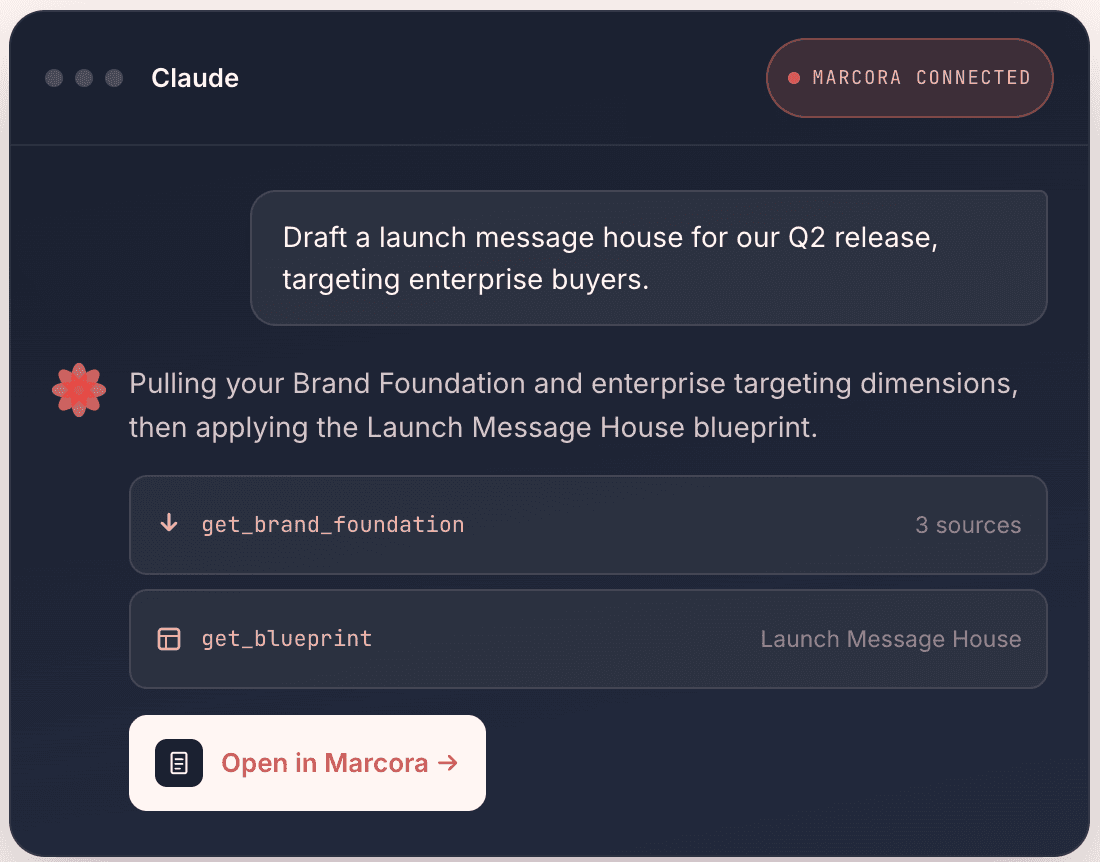
AI tools connect directly — instead of copy-pasting into prompts, your AI tools pull context programmatically. Standards like the Model Context Protocol (MCP) make this possible by providing a standard way for AI to access external knowledge sources.
Context is structured, not just stored — AI needs more than a giant document dump. It needs context tagged by type (positioning vs. competitive vs. feature), by audience (enterprise vs. SMB), and by freshness (last updated, review status).
What This Looks Like in Practice
Before (manual context assembly):
- Open the AI tool
- Search Google Drive for the latest positioning doc
- Find the competitive analysis (is this one current?)
- Copy relevant sections into the prompt
- Generate content
- Spend 30-45 minutes editing for accuracy and voice
- Repeat for every content piece
After (systematic context):
- Open the AI tool (which has access to your context repository via MCP)
- Specify what you need: "Write a competitive comparison blog post targeting mid-market product marketers, focusing on our advantages over [Competitor A]"
- AI pulls current positioning, competitive intel, and relevant customer stories automatically
- Generate content
- Light editing for style (10-15 minutes)
The difference isn't just time saved — it's consistency. Every piece of AI-generated content draws from the same source of truth, so your messaging is aligned across every channel, every team member, and every AI tool.
How to Get Started
You don't need to overhaul everything at once. Start with the context that has the highest impact on your AI content quality.
Start with these three actions:
1. Centralize your positioning doc. Get one canonical version of your positioning, messaging hierarchy, and value propositions. Make it the single source for all AI content generation. Update it monthly.
2. Structure your competitive intelligence. Create a structured comparison for your top 3-5 competitors covering: where you win, where they win, common objections, and recommended positioning. Update it after every competitive deal review.
3. Connect your AI tools. Whether through direct API integration, MCP, or even a structured prompt template library — create a systematic way for your AI tools to access current context instead of relying on manual copy-paste.
Each of these steps takes less than a day to set up and immediately improves every piece of AI-generated content your team produces.
Frequently Asked Questions
Why does AI-generated marketing content sound so generic?
AI content sounds generic because the AI lacks specific product context — your positioning, competitive advantages, customer stories, and brand voice. Without this context, AI writes from general knowledge that could apply to any company in your category.
Can better prompts fix generic AI content?
Better prompts help but don't scale. You end up manually assembling context for every piece of content, different team members use different (often outdated) context, and the preparation time offsets the efficiency gains from using AI.
What is the Model Context Protocol (MCP)?
MCP is an open standard that lets AI tools connect directly to external data sources — like your product context repository — so they can access current, structured information without manual copy-pasting. It's how AI tools move from generic knowledge to product-specific understanding.
How much time does systematic product context save?
Teams that systematically manage their product context report reducing AI content editing time from 45 minutes to 10-15 minutes per piece, according to Demand Gen Report data. More importantly, they report higher consistency across all AI-generated content.
Generic AI content isn't a technology problem — it's a context problem. Marcora gives your AI tools structured, current product context so every piece of content sounds like it was written by someone who actually knows your product. See how it works.