

- November 19, 2026
One Company Context, 123 Blueprints: How the Blueprint Exchange Works
Why GTM documents drift apart, how one shared product context keeps them consistent, and the 123 blueprints built to start from it.
The Same Context in a Different Place
A while back I asked Claude to make me a PowerPoint deck, and it did. Then I wanted an agent working inside the deck itself. There's a Claude integration for PowerPoint on the web that runs alongside your slides, so I tried that. But I couldn't associate it with a project, at least not when I did it, and it didn't have access to the thread that had actually created the deck.
It was a different thread, not in a project. But I was able to use the same Marcora connector there and connect it to my context, so it had all the same context my original thread had. So the context survives whatever project you're in, or whatever Claude interface you're using. Even the Claude Slack integration, let's say, may not be in a project, but it could still use the same Marcora connector.
The useful part is being able to carry the context into another place where you're working. A launch plan and a customer email need that continuity too, even though they're different documents written for different readers.
In Marcora, company facts live in the Reference Library. The Brand Foundation holds the voice rules. Documents draw on both. Context Orchestration connects that context to the work, while Context Intelligence helps keep the library current.
A board update and a customer email will still read differently. They need to agree on the facts, and the next document should start from the current version of those facts.
Where the Documents Start to Disagree
A positioning memo, sales deck and launch email can each make sense on their own and still describe the product differently. The problem becomes easier to see when you put them next to one another.
Look at the answer each gives to “who is this for?” Then look at what it promises. A difference in vocabulary may be harmless. A different audience or product claim needs a closer look.
The author of the deck might have used an older positioning memo. The email might have started from the website. Product marketing can update its own document without the change reaching either of those sources. Nobody has to write badly for the versions to diverge.
Before rewriting them, trace the disagreement. Which source changed, who uses it, and where did the older version get copied? Otherwise, fixing the email leaves the same outdated source available for the next person.
You can do a first pass in about 30 minutes:
- Pick one product and gather five documents that describe it. The homepage, sales deck, launch email, onboarding sequence and board update are a useful set.
- Copy each document's one-sentence description without paraphrasing it.
- Mark differences in audience, claims and vocabulary.
- Trace the differences back to the sources the authors used.
Some differences will be deliberate. Keep those. The ones worth fixing are the conflicting facts or terms that nobody intended to change.
A Reusable Structure for the Next Document
Shared context still leaves the question of how to write the document itself.
Before Marcora, I ran everything through Claude projects. Every time I wanted a persona document or a battlecard, I was reinventing the structure and how to say it right. The context I'd uploaded stopped being accurate, and I stopped adding to it even when I knew it was out of date.
A blueprint supplies the structure for a particular piece of work. It sets out the questions a launch plan or an at-risk account plan needs to answer, then draws on your context to produce a draft. A conventional template gives you a layout to fill in yourself.
The Blueprint Exchange has 123 blueprints, including 101 new ones. Each has a page with an overview and sample output. Those samples use fictitious companies and invented numbers to show the finished document's shape.
For messaging consistency, the Brand Voice, Tone & Messaging Governance Guide is a useful starting point. A voice standard needs enough detail for someone to apply it to their own work. “Be clear” leaves a writer with a lot to decide. Approved terminology and examples of acceptable wording give them something to check against.
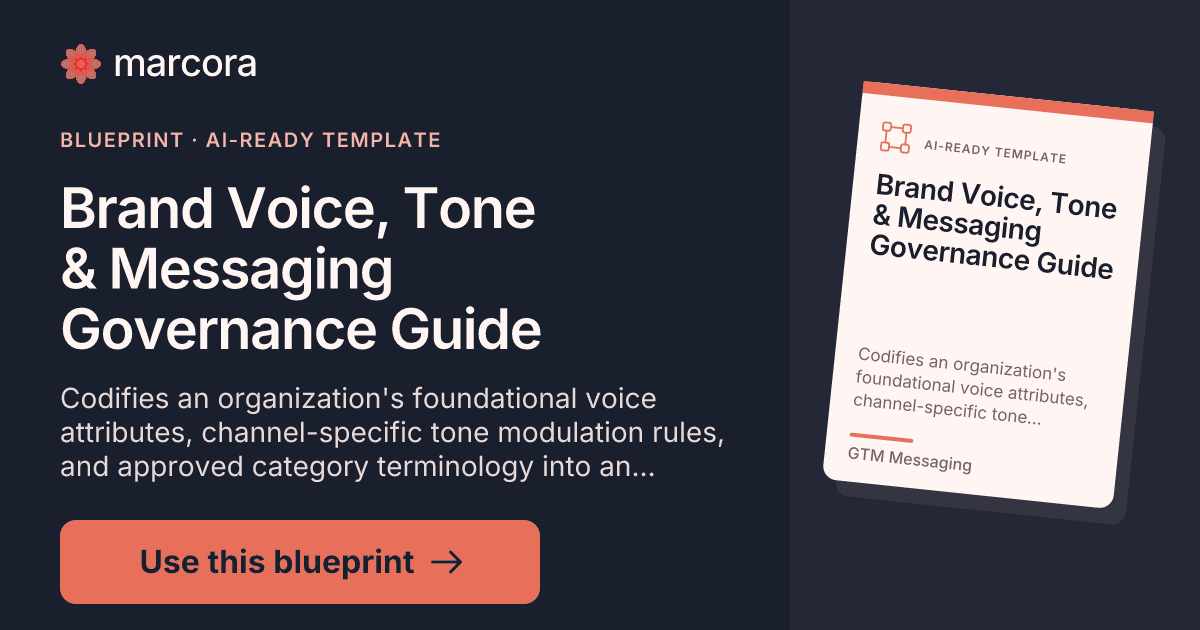
The guide also makes room for tone to change by channel. A keynote and an incident notice shouldn't read alike. Voice attributes, prompt guardrails and pre-publish checks belong alongside those channel rules, where people can use them while writing and reviewing.
Finding the Blueprint You Need
The Exchange's nine categories organize the documents by the work you're doing. You can browse the examples without signing up.
| Work | Category |
|---|---|
| Positioning and audience work | GTM Messaging |
| Pages and articles | Website & Blog |
| Posts and paid campaigns | Social Media & Digital Ads |
| Messages to prospects and users | Email & In-App Messaging |
| Press and event materials | PR & Events |
| Deal and partner support | Sales & Partner Materials |
| Onboarding and renewals | Customer Success |
| Product planning | Product Mgmt & Specs |
| Coordinated sets, such as a launch kit | Multi-Format Blueprints |
This is the first of 15 posts about using those documents together. The series starts with a major launch, a rival on the shortlist and a customer win that becomes proof. Later posts follow work in sales, customer success and product management, as well as founder communications, events and PR. Each part stands alone; new parts link to the ones already live. The schedule is twice a week.
Start with a document you need this week. You can borrow the structure from its sample and use it in your own tool, or import the blueprint to generate a draft from your context. Import is available with a free account, with no credit card required.
Frequently Asked Questions
Why Do GTM Documents Drift Apart?
GTM documents drift apart because each one starts from a different source, at a different time, with a different owner. A positioning update reaches the memo first and the sales deck weeks later, so the two disagree even though both were accurate when written.
What Is a Single Source of Truth for GTM Messaging?
A single source of truth for GTM messaging is one shared place that holds your company facts (products, positioning, audiences, proof) and your voice rules, so every document draws on the same inputs. When a fact changes there, everything written afterward starts from the new version.
How Do You Keep Sales, Marketing, and CS on the Same Messaging?
To keep sales, marketing, and CS on the same messaging, give all three the same source and the same voice standard, and make the source easy to read from where each team works. Each team still needs documents shaped for its job, since a deck, a lifecycle email and a renewal plan differ in form but should agree on facts.
What Is a Blueprint, and How Is It Different From a Template?
A blueprint is a structure for a specific GTM document that draws on your Brand Foundation and Reference Library when you generate it. A template is usually a blank layout you fill in yourself.
Are the Sample Outputs Real Customer Results?
The Blueprint Exchange samples are not customer results. Each one is based on a fictitious company, and the names and numbers in them are made up to show what a finished document looks like.
Is Importing a Blueprint Free?
Each template page offers a free signup to import the blueprint and says no credit card is required.